


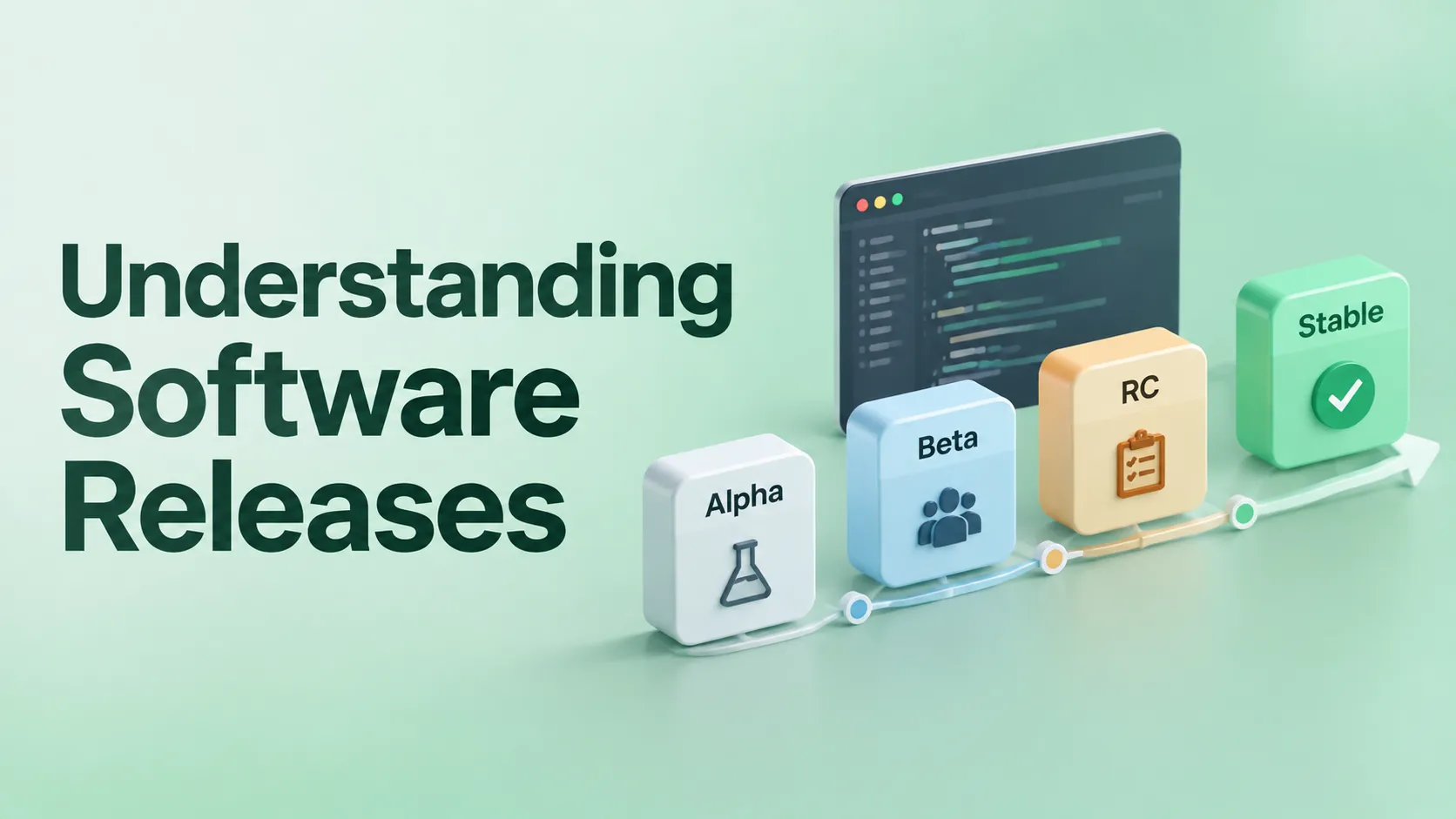
When you use software every day, you usually see only one thing:
A new version is available. Update now.
But behind every software update is a long development process.
Before a version becomes available to millions of users, developers take it through several stages to build, test, improve, and stabilize it.
You may have seen terms like:
- Alpha
- Beta
- Release Candidate (RC)
- Stable Release
But what do these terms actually mean?
To understand them easily, imagine software development like building a house.
Software Development Is Like Building a House
Imagine a construction company is building a new house.
They do not start construction today and invite people to live there tomorrow.
First, they create a plan. Then they build the structure. After that, they inspect everything, fix problems, and finally hand over the keys.
Software is built the same way.
A software product goes through different stages before it reaches normal users.
The journey looks like this:
Idea → Development → Alpha → Beta → Release Candidate → Stable Release
Let’s understand each stage.
1. Alpha: The Early Construction Stage
Alpha is the first usable version of software, but it is still under active development.
At this stage, developers are mainly focused on building the core structure.
Using the house example:
Imagine builders have just created the foundation and basic structure of the house.
The walls may exist, but:
- Some rooms are incomplete
- Electrical wiring may not be finished
- Plumbing may not work properly
- The design can still change
You can walk inside the house, but it is not ready to live in.
The same happens with software during Alpha.
Developers may:
- Add new features
- Remove features
- Change how existing features work
- Experiment with different solutions
Many bugs are expected during this stage.
Alpha versions are usually tested internally by the development team or a small group of testers.
Most normal users should not install Alpha software on important systems.
2. Beta: The Testing and Improvement Stage
After developers build the main structure, the software moves into Beta.
At this point, most planned features are available.
Using the house example:
The house is mostly built.
You have:
- Complete rooms
- Doors and windows
- Electricity
- Water supply
But before people move in, inspectors need to check everything.
Maybe:
- A door does not close properly
- A pipe leaks
- The electricity has problems
- Some areas need improvement
Beta testing works the same way.
The goal is to find problems that developers did not notice.
During Beta:
- Users test the software
- Developers collect feedback
- Bugs are fixed
- Performance is improved
Companies often release Beta versions publicly because real users can discover problems that internal teams cannot.
For example, a feature may work perfectly for developers but fail when thousands of different users try it in different environments.
3. Release Candidate (RC): The Final Inspection Stage
After enough testing and fixing, software reaches the Release Candidate stage.
A Release Candidate means:
“This version could become the final version if no serious problems are found.”
Going back to the house example:
The construction is complete.
The house looks ready.
Now the final inspection happens.
Inspectors check:
- Is everything safe?
- Are there any major problems?
- Does everything work as expected?
If they find a serious issue, builders fix it and perform another inspection.
Software works the same way.
During RC:
- Major features are usually locked
- Developers focus mainly on fixing critical bugs
- The version is prepared for public release
You may see:
- RC1
- RC2
- RC3
Each new RC usually means more issues have been fixed.
4. Stable Release: The House Is Ready
After successful testing, the software becomes a Stable Release.
This is the version recommended for normal users.
In the house example:
The inspection is complete.
The problems are fixed.
The owner receives the keys.
People can now safely move in.
For software:
- Users can install it normally
- Documentation is finalized
- Support teams can help users
- Developers consider it production-ready
For example, when WordPress releases a new major version, millions of websites update to the stable version.
Why Do Software Companies Use These Stages?
Without these stages, companies would build software and immediately release unfinished versions to everyone.
That would create problems:
- More bugs
- Broken features
- Security issues
- Poor user experience
The release process allows developers to gradually improve software before it reaches the public.
Each stage has a different purpose:
| Stage | Main Goal |
|---|---|
| Alpha | Build the core product |
| Beta | Test with real users and fix problems |
| Release Candidate | Final testing before launch |
| Stable Release | Safe version for everyone |
Example: How a WordPress Version Is Built
A major WordPress release follows a similar journey.
For example:
WordPress 7.2
First:
Alpha
- Developers build and experiment with new features.
Then:
Beta
- Users and testers try the upcoming version.
- Bugs are reported and fixed.
Then:
Release Candidate
- The team prepares the final version.
- Only important fixes are added.
Finally:
Stable Release
- WordPress 7.2 becomes available for everyone.
The Simple Way to Remember These Terms
Think about a house:
Alpha = Building the house
The structure is still changing.
Beta = Testing the house
The house exists, but problems are being found and fixed.
Release Candidate = Final inspection
The house is ready unless inspectors discover a serious issue.
Stable Release = Move-in day
The house is officially ready for everyone.
Software development follows the same idea.
A finished product is not created in one step. It is gradually built, tested, improved, and finally released.
